Tuesday, December 8, 2009

'A' faciendum

The 'A' must be made

Apparently, approximately 3/5--a distinct majority--of my students believe that they 'make' their grades, e.g. "I made an 'A' on that exam."

Out of construction paper? Thin air? It must be some sort of miraculous process; would that I knew the secret of grade making. And yet somehow they are all 'making' lousy grades...

It must be a Southern thing, although it doesn't appear to be universal down here.

Tuesday, November 17, 2009

You are now my unfriend

Actually, that would be a new coinage. I don't believe that the adjectival nominal form has made it into the dictionary yet, but the verb "to unfriend" has been announced as Oxford's Word of the Year for 2009. Ah, the joys of Facebook neologisms. We may even need a neologism to define this specific category of neologisms. Any suggestions?

Among the others, I have seen 'sexting' cropping up with increasing frequency, but I believe my favorite is 'funemployed.' I have seen first hand the benefits of funemployment, and they seem, well, pretty fun. And "tramp stamp" is so 2004. Other favorites?

On a much less modern note, the English word 'friend' is historically interesting. It is one of the last remaining traces in Modern English of the old present participal suffix (along with 'fiend') so productive in Latin, where it appears as -ent (e.g. nom. sing. dicens [<*dic-ent-s], gen. dicentis). It comes to us through Germanic in which the suffix was largely lost. Thus it was, originally, 'the loving one.'

UPDATE: Stupid Blogger thought the above notation was a faulty HTML tag and cut my post. It has now been restored in full (though too late for GReader to pick it up, unfortunately).

Wednesday, November 11, 2009

What's in a paper, anyway?

Does it seem strange to non-classicists that this bizarre, five line passage (from Tacitus' Agricola, chapter 12) can serve as the basis for a 20-some page paper? Well, it does to me anyway:
fert Britannia aurum et argentum et alia metalla, pretium victoriae. gignit et Oceanus margarita, sed subfusca ac liventia. quidam artem abesse legentibus arbitrantur; nam in rubro mari viva ac spirantia saxis avelli, in Britannia, prout expulsa sint, colligi: ego facilius crediderim naturam margaritis deesse quam nobis avaritiam.

Britain bears gold and silver and other metals—the value of its conquest. The ocean also produces pearls, but they are dusky and of bluish hue. Certain men believe that some technique is absent in the collectors; for in the Indian Ocean,the pearls are pulled out of the rocks still living and breathing, whereas in Britain, are collected just as they are expelled: I, for my part, would more easily believe that the natural quality of the pearls is lacking than our greed.
Also, I am on a quest for a highly-technical, possibly extant term which, if it exists, would be the term in structural engineering for, more or less, 'the point at which the force would cause a structure to collapse in the absence of a support.' Suggestions are welcome (with credit given! hmm? hmmmm?).

Sunday, November 8, 2009

Huh?

You all are watching football, because that's the only good thing to do on a Sunday afternoon (It sure beats reading Tacitus, at least). Therefore, you probably just saw the NCIS episode teaser. And heard this:
"He's as close to invisible as I've ever seen!"
That is all.

The Wicked Stepmother

We are all familiar with the wicked stepmother character in fairy-tales (Cinderella, etc.). While the Brothers Grimm, those famous collectors of tales (and linguists!), surely had some hand in it, this representation of the stepmother seems to have much wider traction.

There exists already very early in the Greek tradition the concept of a proverbially cruel stepmother. By the time of Hesiod, the stepmother (μητρυιὴ) has distilled, essentially, into a single word formula for cruelty. In the conclusion of Works & Days (822-28):
Αἵδε μὲν ἡμέραι εἰσὶν ἐπιχθονίοις μέγ' ὄνειαρ·
ὄρνιθας κρίνων καὶ ὑπερβασίας ἀλεείνων.

Some days are a great benefits to men on earth,
But others are indifferent, harmless, bringing nothing at all.
Someone praises one kind of day, but few understand them.
Sometimes a day is a stepmother, sometimes a mother.
He is fortunate and blessed of men, who
knowing all these things, works on, guiltless in eyes of the gods,
discerning omens of flight and avoiding transgressions.
The juxtaposition of the mother (μήτηρ) establishes a polar relationship, i.e, cruel : caring. But this minor contextualization is unnecessary for Aeschylus in the 5th century (PB 725-27):
ἵνα
ἐχθρόξενος ναύτῃσι, μητρυιὰ νεῶν.

...where
Salmydessa is, the jagged jaw of the sea,
A hateful host for sailors, the stepmther of ships.
A pan-Indo-European theme? Even broader? I need to do some more investigating.


Thursday, October 29, 2009

The Italo-Celtic Hypothesis

As I mentioned in the last post, I wrote a series of short papers--essentially exercises in comprehension and mental processing. The first concerns the proposed unity of the Celtic and Italic branches of the Indo-European language family prior to their separation into distinct language branches (cf. Indo-Iranian) This hypothesis is based on a number of shared innovations (and, perhaps, retentions), some of which are unique to Celtic and Italic. The paper is a brief examination of the evidence. An excerpt from the introduction:
The Italo-Celtic hypothesis, an Indo-European subgroup uniting Italic and Celtic into a single entity, has, since its inception in 1861 (Lottner Kuhns Beiträge 2.309 ff.), sufficiently intrigued generations of scholars as to gain a kind of cyclical immortality. This sort of immortality is not without death; on the contrary, the theory has perished many times,1 but has always been resurrected—including, notably, by Cowgill 1970 from Watkins 1966.2 The principal appeal of this and other theories of subgrouping lies in their contribution toward the resolution of a question fundamental in Indo-European studies, as framed by Watkins: “wie es eigentlich gewesen?” (1966: 29). An intermediate Italo-Celtic subgroup, existing in the vast temporal grey space between Proto-Indo-European and its relevant end-points, i.e., the daughter languages of the separate Italic and Celtic subgroups, provides valuable insight as to the process.
For the interested, the entire paper can be found here.

Tuesday, October 27, 2009

mutetur et resurgat

May it be changed and rise again.

My long absence from blogging has been no accident. I found the rigidity of this blog’s self-imposed form and function off-putting, and was thus disinclined from using it as it should be (and hopefully shall be) used: as an open, easily accessible record of my thoughts, usually sketched in broad and indefinite strokes as, indeed, they tend to occur.

I was nudged back to De Grypis by three episodes in particular. The first was my encounter with the reflections of Chris Blattman, Yale development economist and one of my favorite bloggers, upon his two-year blogiversary. He recalls economist Dani Rodrik’s notion of his blog as academic memory (with Google), and agrees wholeheartedly. Rodrik, in fact, wrote:

[O]ne of the unexpected scholarly benefits of having a blog is that it is like keeping an intellectual journal. You get an idea, you jot it down in your blog. Some months later, you vaguely remember having had the idea and you google your own blog to recover it. I am not kidding: I google my own blog all the time...

I can well-appreciate his sentiment. Many are the hours of frustration I have spent groping for an idea which, only just yesterday (or two hours ago, or two minutes ago) so clear and comprehensible, has slipped beyond the reach of memory, especially of late. These are, at best, wasted hours and, at worst, wasted ideas.

A second episode really brought this home. In my research on an unrelated topic, I came across a linguistic analysis of a particular speech in the Iliad which may reinforce certain suggestions I made in a paper from my undergraduate days. Now that 2007 idea was developed into a full paper (misguidedly, perhaps—it was not received warmly by the instructor). I have that paper saved on file and so, if I choose, I may reinvestigate my initial claims in light of new evidence. But there are many ideas which do not end up in the permanent record; they are jottings in the margins of texts, little notes in the recesses of notepads that, neglected until the time comes for a full-scale paper, may be at that point inaccessible. These notes will find their natural home in a blog.

The third episode consists of the recent series of short papers I have written for a general class on Indo-European languages. These assignments require one to distill complex, far-reaching concepts--often treated at length in article, monograph, or book—into a brief 3-4 page paper. The process itself is immensely helpful in understanding the material, and the ideas extracted, boiled-down to their essentials, are suddenly seem more applicable in a wide set of contexts. They have certainly facilitated the strong conceptual framework that is integral to the study of Classics and even more so, Indo-European. Since the academic necessity of such papers that are, in fact, primarily mental exercises, will soon expire, I will turn to this blog—which, I believe, is an ideal platform.

The thoughts appearing here need not be fully developed or meticulously treated; such careful attention will be rare, as they are more useful to me as material for separate projects and, as it is likely, no more interesting (or perhaps, even less so) to my readers wholly fleshed out and with an eye for the particulars. Nor will I be bound to the limited domain of Classics, or even the more extensive domain of Indo-European studies. These remain my principal interests, a fact which will show in the frequency of subjects on which I will offer my thoughts.

Yet I would add that as I continue my studies, I have found that my observations outside my discipline can often be fruitful within it; at the very least, they tend to fuel the analytic thought-processes so vital to a thorough understanding of ancient languages and literature, inter alia. Moreover, the exercise of semi-daily writing should strengthen those prose composition muscles that might otherwise atrophy in the daily grind of a reading and translation heavy course load.

Please bear with me in these motives, for though generally selfish, they are not entirely so; it is my firm belief that these oft-fleeting notes will be more interesting to you than that which came before, and much more so than nothing at all.

I’m back.

Wednesday, September 16, 2009

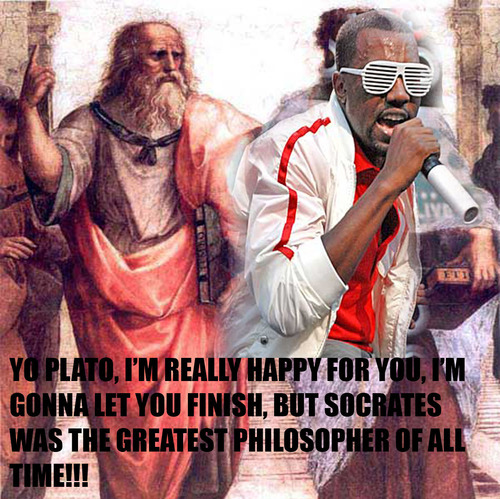
Ω Σωkρατη!


O Socrates!

Kudos to Abe for blogging this excellent meme. The entire collection is here.

And the words "meme" and "kudos" are more or less (less or more, really) directly from Greek.

(Update: My favorite.)

Wednesday, April 22, 2009

'malignus interpres' redux

I have just put up an updated version of my paper on Martial's malignus interpres. The Scribd introduction below:
This paper undertakes an investigation of the oft-neglected 'malignus interpres' who inhabits the preface to Martial's first book of epigrams. The study attempts first to resolve the textual problem (inscribat/scribat) that plagues the line, and moves on to explore the 'interpres' using both diachronic and comparative synchronic methods. It ultimately attempts to formulate an answer to the question--Who is the interpres?--with regard to both identity and function.
I urge you lovers of Latin poetry--the majority of my readers for sure--to go check it out.

On an encomiastic note, Scribd is incredible! It offers free access to excellent, useful (and expensive!) books like J.N. Adams's Bilingualism and the Latin Language. Classicists take note--the future is here!

Thursday, April 2, 2009

hoc adfigere cunctabam...

I have been delaying posting this...for fear of it being adopted as a focal point in the ever-eloquent conservative argument against government stimulus.

The Fed's recent announcement (link with explanation by Krugman) of its new, nontraditional expansionary policy of "quantitative easing"--the functional equivalent of printing money--is an attempt to expand the monetary base with interest rates already hovering at the zero bound. Certainly conservatives have been less opposed to this measure than fiscal efforts (more often than not, on spurious grounds--the reemergence of the misguided 19th century British "Treasury View" has been the recent scourge of Brad DeLong among others); nevertheless, I though it prudent not to add ammunition, particularly as ludicrous arguments seem to dominate the discourse--even beyond Fox News.

The fact, however, illustrates an important lesson about etymology: historical context is important, at times to the extent that it is the only way of understanding a word's roots. The English words "money" and "mint" are derived from the Latin verb monere "to warn, to admonish"...

Hold the head-shaking.

"Money," in this case Roman coin, was originally "minted" at the temple of Iuno Moneta--Juno the Admonisher. The term is a transference by metonymy.

Let us hope, for the sake of an already pedantic national discourse, that I have not gravely erred.

Friday, March 6, 2009

Quis est Martialis 'malignus interpres'?

Who is Martial's 'malignus interpres'?
The mysterious malignus interpres has been received as an unwelcome intruder to Martial’s preface; he occupies vital space—the traditional domain of a declaration of poetic program—but his presence has, thus far, served only to obscure a line that is autonomously problematic. Since the early 17th century conjecture of Heinsius, critical editions of Martial have failed to reach a consensus whether to read the standard scribat or, with Heinsius, inscribat. The identity of the malignus interpres has been subsumed by this controversy and, consequently, an investigation of the enigmatic interpres has been unjustly neglected. He is hapax legomenon in Martial, and his prominent position in the preface suggests semantic marking—which necessarily implies the question: Why interpres? It is a failure of scholarship that an answer has not yet been provided...
Until now.

Thursday, February 26, 2009

in nomine Patris et Filii et...huh?

In the name of the Father, the Son, and the...huh?

XKCD (via Brad DeLong)

Friday, February 20, 2009

quaestio publica

A public poll.
If someone came up to you in the street and said "Isn't it paradoxical that the Catullan Martial is not a neoteric Martial?" would you know what he/she meant?
Well...would you?

Thursday, February 19, 2009

Quid est in nomine bestiarum?

What is in the name of animals?

Language Log has an interesting post concerning the formation of scientific nomenclatures which are named in honor of those who discovered them. Sally Thomason wonders why female scientists receive attribution with only the feminine genitive suffix -ae but males with -i or -ii.

The gist: non-Latin names of these biologists has been notoriously problematic, and different methods of Latinization have led to two different surface forms of the masculine genitive suffix. So while evidence of it is slim, there is no reason why femine suffixes in -iae and -ia should not be present.

However, contributions by Ben Fortson and Don Cameron are always worth reading.

Fortson:

So the reason all this is relevant is that let's say you want to Latinize a non-Latin family name. A non-Latin family name kind of corresponds to the gentilicium but also kind of corresponds to the cognomen; there's no exact equivalent either way. So one could defensibly tack on either -ius or -us to the non-Latin name to do the trick. Falling into the former camp are Latinized names like Gronovius (originally Gronov), Lipsius (-us or -ius and usually the correct one was used. This can extend to German names of ultimately Latin origin, e.g. Camerarius being the rendering of Camerer (chamberlain).

Mutatis mutandis the same issues obtain with women's last names. The names of Roman women were just feminizations of male names (Julia Greyia instead of Greya (to form the genitive greyae in Bathylagus greyae).
and Cameron:
The International Code of Zoological Nomenclature (4th edition, Sec. 31.1.2) specifies one -i, but under 31.1.3, about preservation of the original spelling, both cuveri and cuverii are admissible. The trouble comes from different conventions of Latinizing modern proper names. Originally in Latin names like Marcus have genitive Marci and names like Livius have genitive Livii. So do you want to Latinize my name as Cameronus or Cameronius? You have a choice. Then the genitives would be Cameroni or Cameronii. Modern custom following the Code is to use one -i.
Check out the rest of the post here.

Friday, February 13, 2009

saevus...Boreas?

Savage...Boreas?

Yesterday, the ferocious winds that laid waste to the greater East Brunswick area led to calamity for AlmostWorthKnowing's Abe Tran. As he documents here, his car suffered the unfortunate wrong-place, wrong-time fall of a hefty tree branch on its windshield and upper hood. Our condolences go out to him and his automobile.

He attributes this unlucky turn of fate to Boreas--in Greek mythology, God of the North Wind. However, after closely consulting the modern day weather augurs, I would say that the blame more accurately belongs to Zephyrοs--the West Wind--and it suggest that Mr. Tran ought direct future propitiations to this fickle Deity.

Thursday, February 12, 2009

alienus in terra aliena

Stranger in a Strange Land.

Not long ago, Brett and I finished reading Robert Heinlein's 1961 sci-fi classic Stranger in a Strange Land. Amidst the general fantastic silliness, the untranslated Martian word grok stood out as particularly ridiculous--and yet somehow, it was catchy (perhaps in the worst kind of way). Thus while the predictable plot and laughably stereotypical characters have quickly faded into hazy recollection, grok lives on in my lexicon...and apparently, in that of others as well.

It is casually used by Felix Salmon and Alex Tabarrok.

Also, while recently perusing the blogosphere, I stumbled upon this:
Warlocks and Morlocks
Don't grok door locks.
And finally, today, in my quest to determine the the identity of Martial's malignus interpres, I was seeking out a translation for German verstehen:


to grok [sl.] (Amer.) verstehen | verstand, verstanden |

I believe I speak rightly when I say--IT'S EVERYWHERE!

Wednesday, February 4, 2009

Quidcumque nobis Romani fecere?

What have the Romans ever done for us?

The reminder of this classic clip comes via Chris Blattman.

Saturday, January 31, 2009

Friday, January 30, 2009

συλλογισμός

A deductive argument.
And, what is worse, the reader often shares the writer's prejudices, and is far too well pleased with his conclusions to examine either his premises or his reasoning. Stand on a barrel in the streets of Bagdad, and say in a loud voice, "Twice two is four, and ginger is hot in the mouth, therefore Mohammed is the prophet of God," and your logic will probably escape criticism; or, if anyone by chance should criticise it, you could easily silence him by calling him a Christian dog.
Again, from A.E. Housman's The Application of Thought to Literary Criticism.

Thursday, January 29, 2009

alea iacta est

The die is cast.*

Via Newsvine, a comparison of the passing of the most recent economic stimulus bill...with Caesar crossing the Rubicon:

It was in the winter of 49 BC that Julius Caesar lead his armies across the Rubicon river. One imagines the glint of a veiled sun off frost-sheened armor and curved shields as thousands upon thousands of legionnaires wade through waist high water in the January cold at the command of a crimson cloaked Caesar. Their destination was Rome and there was no turning back - in crossing the Rubicon they had invaded Italy, declared war upon the government they served, and cast their lots with their commander. Alea iacta est, Caesar intoned. "The die is cast."

The Republican Party crossed its own Rubicon earlier this week, its ultimate fate just as uncertain as that which faced the man-who-would-be-emperor more than 2000 years ago. Barack Obama's stimulus package passed the US House of Representatives on Wednesday without a single Republican vote. Though the plan has been derided by the Right as full of pork and insufficiently focused upon economic stimulation, the political reality is that no one will remember these critiques in a few months' time...

The Republicans have crossed the Rubicon, they march upon the nation itself and will see it in ruin before accepting anything less than the full measure of victory. From this there can be no return and no half measures. The Republican party will succeed in its opposition or be destroyed in the process. Alea iacta est.

The parallel does not seem unreasonable, although I cannot say it was my intuitive reaction to the bill.


*I prefer "The die is cast" to the perhaps more common "The die has been cast." The former translation seems to really hammer the home the traditional stative sense of the perfect, more fitting here.